
Decoding Bale Density & System Pressure: NKW Horizontal Baler Configurations
Decoding Bale Density & System Pressure: NKW Horizontal Baler Configurations
Two horizontal hydraulic balers can share a feed opening, a bale chamber and a control philosophy, yet produce bales with very different weight per cubic metre. The reason sits in two datasheet numbers that are easy to skim past: system pressure and main cylinder force. On the NKW Q-series built by nkbaler, those numbers are published alongside a rated bale density band, so the link between hydraulics and output is visible before a machine is ordered. The series runs from 21 MPa at 80T and 125T, through 25 MPa at 160T, up to 30.5 MPa at 200T, with rated bale densities spanning roughly 300 to 700 kg/m³ depending on the material stream.
This guide is written for the engineers, plant managers and technical buyers who have to set realistic throughput and density expectations before the steel is cut. It explains how pressure becomes force, how force becomes density, and how the four core NKW configurations — NKW80Q, NKW125Q, NKW160Q and NKW200Q — are tuned for different material streams.
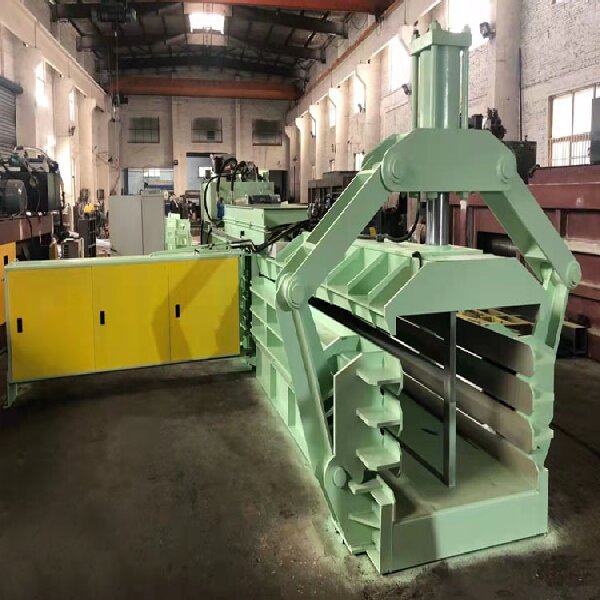
A Q-series horizontal hydraulic baler from nkbaler, shown with its bale chamber and main compression frame.
Problem Definition: Why Tonnage Alone Cannot Predict Bale Density
Main cylinder force describes how much push the machine can generate at the ram. Bale density describes how much mass ends up inside one cubic metre of finished bale. Those two quantities are related, but they are not the same thing, and treating them as interchangeable is the single most common source of mismatched expectations in horizontal baler procurement.
The gap between the two appears in four places:
- Chamber cross-section. Force is distributed across the face of the bale. A 1100 × 1250 mm bale face on the NKW160Q receives the same applied force spread over a larger area than the 1100 × 800 mm face of the NKW80Q, so the two machines cannot be compared on tonnage alone.
- Effective cylinder area. The NKW80Q and NKW125Q both operate at 21 MPa, yet their rated main cylinder forces are 80T and 125T respectively. Pressure is identical; the force differs because the effective cylinder area differs.
- Material compressibility. Film, OCC, PET bottles, mixed rigid plastic and metal scrap each reach a different ceiling under the same applied force. The published density band for a model is a material-dependent range, not a fixed constant.
- Throughput versus density. A machine can be rated for high tonnage per hour and a moderate density band at the same time. Capacity and density are separate specifications and must be checked separately.
The practical consequence is that a buyer who selects a machine on tonnage alone may end up with a bale that is too light for an export container, or a machine that is heavier and more expensive than the material stream actually requires.
Industry Background: Where Density Requirements Come From
Demand for baling equipment tracks the volume of recoverable material moving through recycling, waste-to-resource and agricultural supply chains. Transparency Market Research valued the global baler machine market at USD 6.6 billion in 2024 and projects USD 11.4 billion by 2035, with Asia Pacific accounting for 40.2% of 2024 revenue. Within the wider recycling equipment market, the baler press segment represented 24.5% of the total in 2025 according to Grand View Research.
Trade data points in the same direction. Volza recorded China as a leading exporter of hydraulic baling presses under HS Code 8462, with 91 significant shipments between June 2024 and May 2025. Separately, the global metal baler segment for scrap metal processing was estimated at USD 2.172 billion in 2024 by Market Research Future — a reminder that the same basic hydraulic architecture serves both fibre and metal streams, but at very different force and density levels.
Three commercial pressures push buyers to specify density more precisely than they did a decade ago: rising freight cost per container, mill and smelter intake specifications that penalise loosely packed bales, and the labour cost of handling bales that fall apart in transit. Each of those pressures translates back into a force and pressure requirement on the machine datasheet.
How Pressure Becomes Density on an NKW Horizontal Baler
The path from a pressure gauge reading to a finished bale weight follows four steps, and every step has a limit.
1. System pressure is the input
System pressure is the hydraulic oil pressure the power pack delivers to the main cylinder circuit. On the NKW Q-series this is published as 21 MPa for the NKW80Q and NKW125Q, 25 MPa for the NKW160Q, and 30.5 MPa for the NKW200Q.
2. Cylinder area converts pressure into force
Main cylinder force is the product of system pressure and the effective area of the main ram. Because effective area changes with cylinder bore, two machines running at the same 21 MPa can produce very different force — which is exactly what separates the NKW80Q at 80T from the NKW125Q at 125T.
3. Chamber geometry converts force into compaction pressure
The pressure the bale actually experiences is the cylinder force divided across the cross-section of the baling chamber. This is why bale face dimensions matter as much as tonnage. The NKW125Q and NKW200Q share the same 1100 × 1100 mm bale face, but the NKW200Q applies 200T at 30.5 MPa against the NKW125Q's 125T at 21 MPa. With chamber geometry held constant, the additional force and pressure are what lift the rated density from 500–600 kg/m³ to 650–700 kg/m³.
4. Material compressibility sets the ceiling
No amount of force will compress a material beyond its own structural limit without damaging the bale or the machine. This is why the NKW160Q, which applies 160T at 25 MPa, carries a wider rated band of 400–600 kg/m³: different materials passing through the same 1100 × 1250 mm chamber settle at different points inside that range.
Pressure and force across the NKW Q-series
| Model | System pressure | Main cylinder force | Bale face (W × H) | Bale length | Rated bale density |
|---|---|---|---|---|---|
| NKW80Q | 21 MPa | 80T | 1100 × 800 mm | up to ~1600 mm | 300–400 kg/m³ |
| NKW125Q | 21 MPa | 125T | 1100 × 1100 mm | up to ~1600 mm | 500–600 kg/m³ |
| NKW160Q | 25 MPa | 160T | 1100 × 1250 mm | up to ~1600 mm | 400–600 kg/m³ |
| NKW200Q | 30.5 MPa | 200T | 1100 × 1100 mm | up to ~1800 mm | 650–700 kg/m³ |
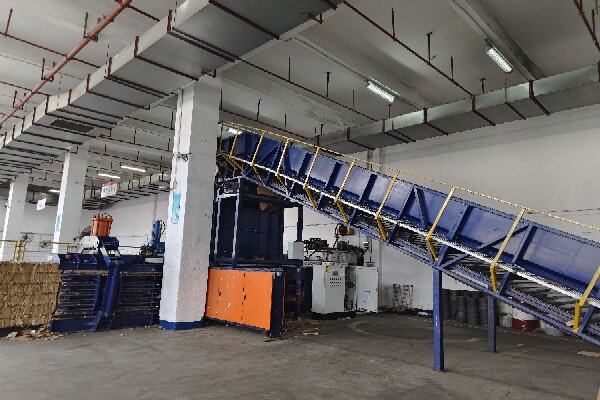
Mainframe and bale chamber of an NKW horizontal hydraulic baler. Bale face dimensions determine how cylinder force is distributed across the bale.
Step-by-Step Breakdown: Matching an NKW Configuration to a Material Stream
The selection logic below is the sequence an engineer can follow to move from a material description to a defensible machine choice. Each step uses published NKW parameters rather than assumptions.
Step 1 — Characterise the material stream, not just the material name
Two plants can both bale "plastic" and need completely different machines. Record bulk density, particle size, moisture and whether the stream is film, bottle, rigid moulding or mixed. The NKW80Q, for example, is documented with film baling images in the nkbaler library, reflecting the light, high-volume streams its 300–400 kg/m³ band suits.
Step 2 — Convert the offtake requirement into a target density
Start from what the receiving mill, smelter, container loading plan or storage yard will accept. That figure, expressed in kg/m³, becomes the minimum the machine must reliably reach for that material.
Step 3 — Work back from density to force
Find the model whose rated band covers your target for the material in question. If the target falls between bands, the next model up in force is usually the safer starting point, because the density band is a range and the practical result depends on how the specific stream behaves.
Step 4 — Check throughput against the line, not against the bale
Density and capacity are independent. Rated capacities in the Q-series run from 3–5 T/hour on the NKW80Q, through 10–12 T/hour on the NKW125Q, to 12–15 T/hour on both the NKW160Q and NKW200Q. A plant that needs 13 T/hour cannot use the NKW125Q regardless of its density band.
Step 5 — Size the feed opening and conveyor to the real infeed
Feed openings scale with the chassis: 1500 × 800 mm on the NKW80Q, 2000 × 1100 mm on the NKW125Q and NKW160Q, and 2400 × 1100 mm on the NKW200Q. Conveyor length follows: 12,000 mm on the NKW80Q and NKW125Q, 14,000 mm on the NKW160Q and NKW200Q. An undersized feed opening throttles throughput long before the main cylinder reaches its limit.
Step 6 — Confirm duty cycle and operating environment
Baling lines rarely run as batch operations. The nkbaler application profile for these machines specifies continuous automatic operation with PLC-controlled cycles and 24/7 industrial duty mode, and the equipment is designed for operation in high temperature environments. Matching equipment in a typical line includes the conveyor, wire or rope, and woven bags for downstream handling.
Step 7 — Validate build, testing and delivery
Configuration decisions are only useful if the machine arrives as specified. nkbaler operates on an OEM/ODM basis with parameter-level customization at a minimum order quantity of 1 unit, applies 100% testing before shipment, and publishes a lead time of 30–45 days against a monthly capacity of 10 units.
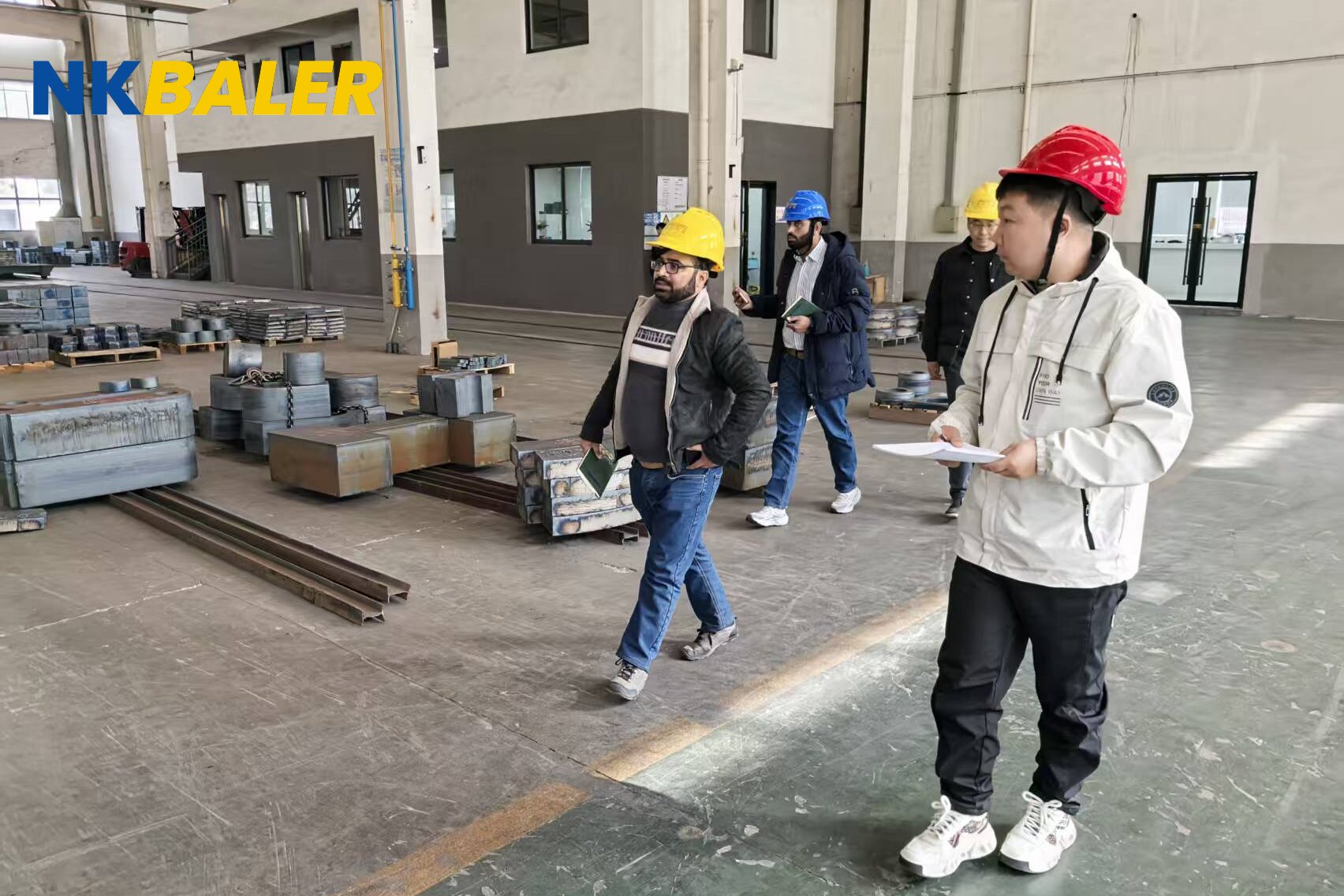
Assembly and preparation area at the nkbaler facility, where each unit is configured to the agreed parameters before testing.
Use Cases: How Density Targets Play Out in Practice
Light film and high-volume plastic streams
Post-consumer film is bulky and springs back quickly, so it needs repeated compaction rather than a single high-force stroke. The NKW80Q, rated 300–400 kg/m³ with a 3–5 T/hour capacity and a 1100 × 800 mm bale face, sits at the light-material end of the Q-series. Its 15-tonne mainframe and 30 kW + 11 kW motor configuration make it the smallest chassis in the range without sacrificing continuous automatic PLC-controlled operation.
Bottle, PET and mixed rigid plastics
Rigid containers hold shape longer than film and benefit from a larger compaction face. The NKW125Q raises force to 125T at the same 21 MPa, widens the bale face to 1100 × 1100 mm and lifts capacity to 10–12 T/hour with a 500–600 kg/m³ rated density. Its 22-tonne mainframe and 37.5 kW + 11 kW drive reflect the additional work the denser bale requires.
OCC, waste paper and mixed fibre
Fibre streams sit in the middle of the density spectrum and are sensitive to the height of the chamber. The NKW160Q moves to 25 MPa, 160T and a taller 1100 × 1250 mm bale face, with a wider 400–600 kg/m³ band and 12–15 T/hour capacity. Its 28-tonne mainframe and 45 kW + 11 kW drive support the higher pressure class.
High-density export and metal-adjacent streams
When the density target is set by container loading or by a downstream buyer's intake specification, the top of the range becomes relevant. The NKW200Q applies 200T at 30.5 MPa to the same 1100 × 1100 mm bale face as the NKW125Q, extends bale length to approximately 1800 mm, and is rated 650–700 kg/m³ at 12–15 T/hour. The cost of that capability is visible in the chassis: a 34-tonne mainframe and a conveyor of approximately 7 tonnes.
Field reference: recycling station and agricultural baling
Two nkbaler project references illustrate how density and duty interact in the field. A recycling station manufacturer in Indonesia operates a horizontal baler configuration for waste plastic and waste paper baling, with one unit in service, a stated service life expectation of 10–15 years, stable operation, and documented low noise and low energy consumption. An agricultural manufacturer in Pakistan operates a baling line for straw and alfalfa, with one unit in service, two years of stable operation and low noise as the highlighted result. In both cases the value of the machine is measured by continued stable output, not by a single headline density figure.
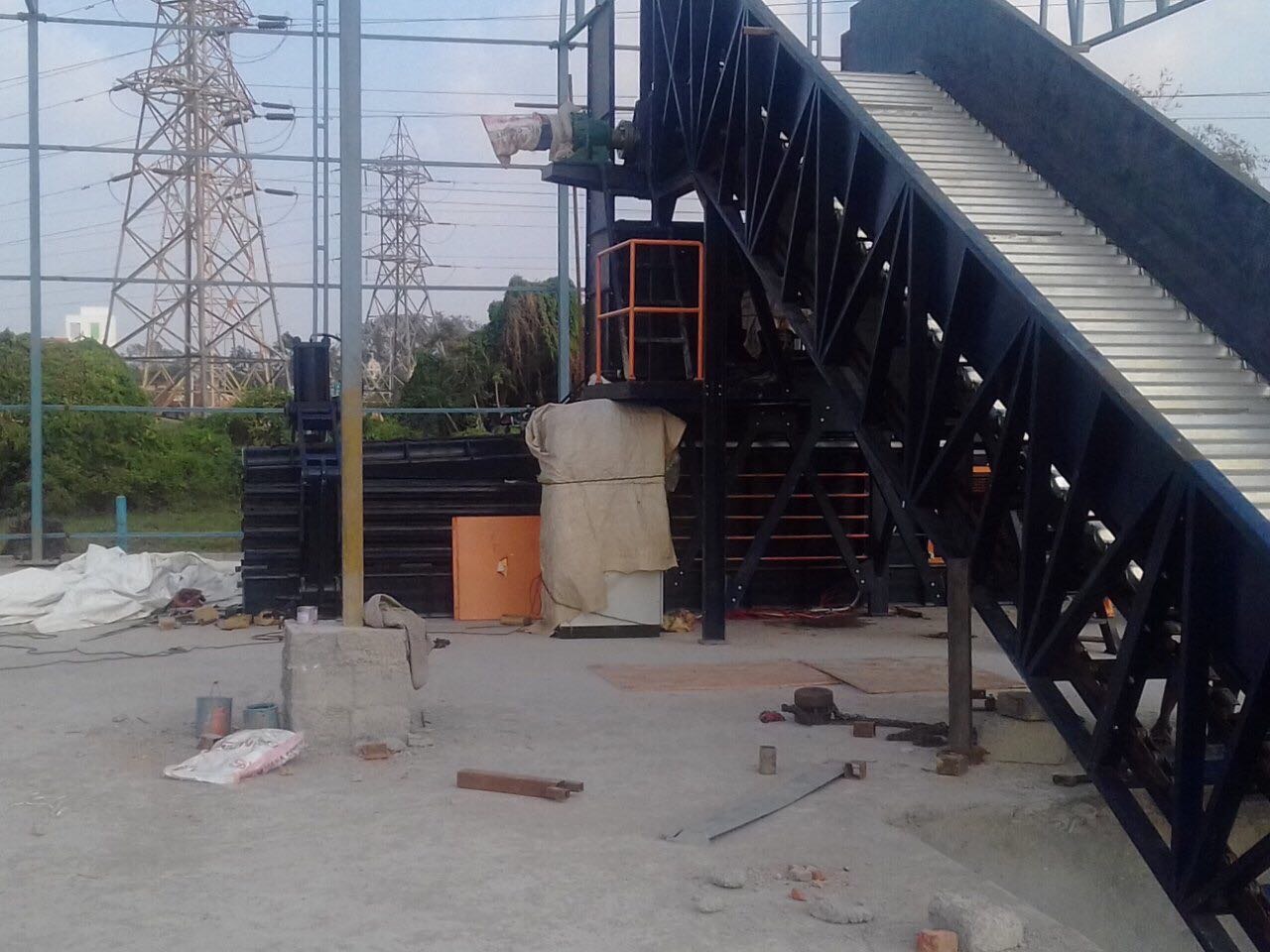
A Q-series machine set up for film and light plastic material — the stream type that defines the lower end of the density band.
Comparison Table: NKW80Q vs NKW125Q vs NKW160Q vs NKW200Q
| Parameter | NKW80Q | NKW125Q | NKW160Q | NKW200Q |
|---|---|---|---|---|
| System pressure | 21 MPa | 21 MPa | 25 MPa | 30.5 MPa |
| Main cylinder force | 80T | 125T | 160T | 200T |
| Rated bale density | 300–400 kg/m³ | 500–600 kg/m³ | 400–600 kg/m³ | 650–700 kg/m³ |
| Bale size (W × H × L) | 1100 × 800 × ~1600 mm | 1100 × 1100 × ~1600 mm | 1100 × 1250 × ~1600 mm | 1100 × 1100 × ~1800 mm |
| Feed opening | 1500 × 800 mm | 2000 × 1100 mm | 2000 × 1100 mm | 2400 × 1100 mm |
| Capacity | 3–5 T/hour | 10–12 T/hour | 12–15 T/hour | 12–15 T/hour |
| Main motor power | 30 kW + 11 kW | 37.5 kW + 11 kW | 45 kW + 11 kW | 45 kW + 11 kW |
| Mainframe weight | 15 t | 22 t | 28 t | 34 t |
| Mainframe size (L × W × H) | about 9.8 × 4.3 × 1.4 m | about 11 × 2.3 × 2.9 m | about 11 × 2.3 × 2.9 m | about 11 × 4.3 × 5.8 m |
| Conveyor | 1200 mm × 12,000 mm, 4 kW | 2000 × 12,000 mm, 7.5 kW | 2000 × 14,000 mm, 7.5 kW, about 5 t | 2000 × 14,000 mm, 7.5 kW, about 7 t |
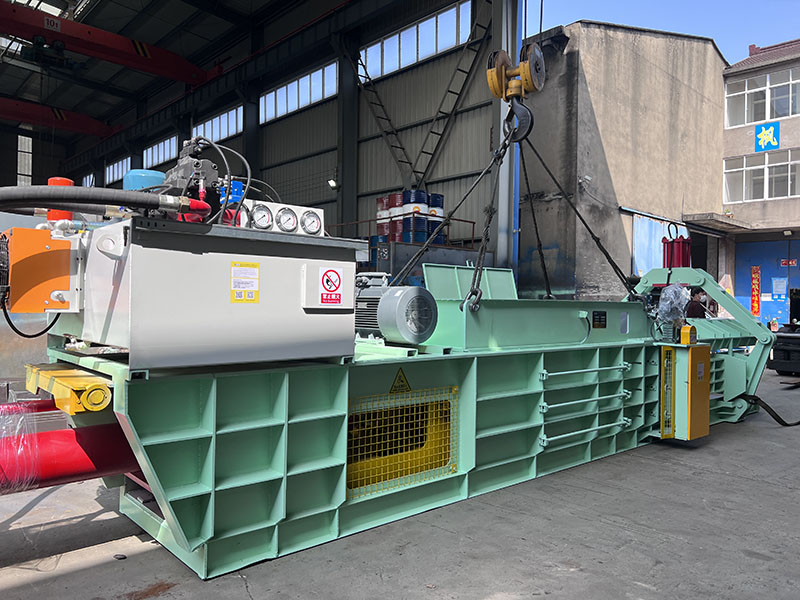
Conveyor-fed horizontal hydraulic baler configuration. Conveyor length and motor rating scale with the chassis size in the Q-series.
Limits and Trade-offs Engineers Should Accept Up Front
Higher density is not automatically better, and the published figures make the trade-off measurable rather than theoretical.
- Weight and foundation. Mainframe weight rises from 15 t on the NKW80Q to 34 t on the NKW200Q. Floor loading, handling equipment and installation planning all change with that step.
- Installed power. Main motor power climbs from 30 kW + 11 kW to 45 kW + 11 kW across the same span, with conveyor motors rising from 4 kW to 7.5 kW.
- Footprint. The NKW200Q mainframe is documented at roughly 11 × 4.3 × 5.8 m against roughly 9.8 × 4.3 × 1.4 m for the NKW80Q, and its conveyor is 14,000 mm long carrying approximately 7 tonnes.
- Density band, not density guarantee. Every rating in the table is a range because the outcome depends on the material. A 400–600 kg/m³ band on the NKW160Q means the machine can operate across that span; it does not mean every stream will reach 600 kg/m³.
- Chamber geometry is not interchangeable. The NKW125Q and NKW200Q share a bale face but differ in force, pressure and bale length, so bale handling and strapping downstream may need to be re-planned when moving between them.
Frequently Asked Questions
What safety and compliance standards apply to a horizontal hydraulic baler installation?
Compliance requirements differ by machine type and market, and they should be confirmed at the specification stage rather than after delivery. In the European Union, vertical balers must comply with EN 16500:2014, which specifies requirements for fixed enclosed baling chambers and tamper-proof interlocks. In the United States, commercial balers must adhere to ANSI Z245.51-2013 for design and construction safety, and ANSI Z245.5-2013 for installation and operation. Buyers should confirm which standard applies to their specific machine type, chamber design and destination market before finalising the configuration.
Can one NKW baler deliver both high throughput and a high bale density?
Yes, within the limits of the chassis, because throughput and density are separate specifications. The NKW160Q is rated at 12–15 T/hour with a 400–600 kg/m³ density band, and the NKW200Q is rated at the same 12–15 T/hour with a higher 650–700 kg/m³ band, using 200T of main cylinder force at 30.5 MPa. At the other end, the NKW80Q is rated 3–5 T/hour at 300–400 kg/m³. All Q-series machines are documented for continuous automatic operation with PLC-controlled cycles and 24/7 industrial duty mode, and are designed for high temperature environments.
What drives the cost difference between the NKW Q-series models?
The cost drivers are the specification steps that separate the models: system pressure (21 MPa, 25 MPa and 30.5 MPa), main cylinder force (80T, 125T, 160T and 200T), mainframe weight (15 t, 22 t, 28 t and 34 t), main motor power (30 kW + 11 kW rising to 45 kW + 11 kW), conveyor length (12,000 mm rising to 14,000 mm) and conveyor motor rating (4 kW rising to 7.5 kW). Feed opening size also scales, from 1500 × 800 mm to 2400 × 1100 mm. Matching the smallest chassis that meets the required density band and throughput is the most direct way to control capital cost.
How can a configuration be validated before a full commitment?
nkbaler works on an OEM/ODM basis with parameter-level customization and a minimum order quantity of 1 unit, so the density band, cylinder force, feed opening and conveyor specification can be defined against a specific material profile before production begins. Every unit is 100% tested before shipment, and monthly production capacity is 10 units. Because the order quantity floor is a single machine, a first unit can serve as the validation reference for a wider line roll-out.
What is the lead time for an NKW horizontal hydraulic baler, and what is the next step?
Published lead time for the NKW Q-series is 30–45 days, against a monthly capacity of 10 units and a minimum order quantity of 1 unit. To move from specification to quotation, prepare the material profile, the target bale density in kg/m³, the required throughput in tonnes per hour, and the site power supply and available footprint, then contact the nkbaler team. The full specification set for the NKW Q-series and the wider baling range is available in the nkbaler product brochure, and configuration questions can be sent directly to Sales@nkbaler.com or via WhatsApp on +86 15021631102.
Set the Density Target First, Then the Machine
Send nkbaler your material profile, target bale density and required tonnes per hour, and the team will confirm which Q-series configuration — NKW80Q, NKW125Q, NKW160Q or NKW200Q — meets the requirement without over-specifying the chassis.
Email: Sales@nkbaler.com | WhatsApp: +86 15021631102 | Download the brochure
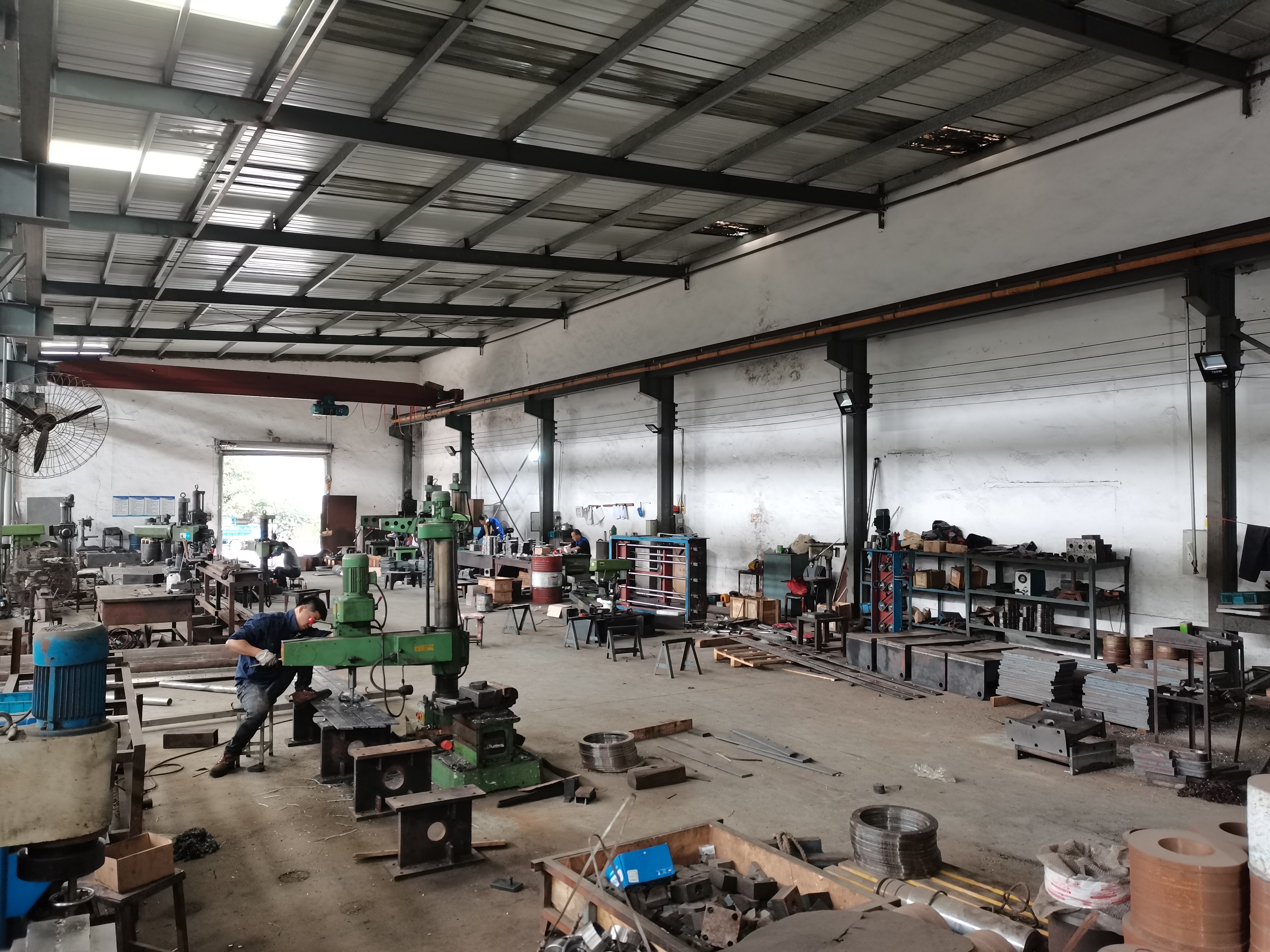
Workshop assembly at nkbaler, where each horizontal hydraulic baler is built to the agreed parameters and 100% tested before shipment.
Conclusion
Bale density is a physical outcome, not a marketing claim. On an NKW horizontal hydraulic baler it is set by the interaction of four things: system pressure (21 MPa, 25 MPa or 30.5 MPa), main cylinder force (80T to 200T), bale chamber geometry, and how far the incoming material will actually compress. Reading those four inputs together is what allows an engineer to predict output instead of hoping for it.
The Q-series maps those inputs onto a clean progression. The NKW80Q takes light, bulky streams at 300–400 kg/m³ and 3–5 T/hour. The NKW125Q steps up to 125T and 500–600 kg/m³ at 10–12 T/hour. The NKW160Q introduces the 25 MPa class with a taller 1100 × 1250 mm bale face and a 400–600 kg/m³ band at 12–15 T/hour. The NKW200Q applies 200T at 30.5 MPa to reach 650–700 kg/m³ on the same bale face as the NKW125Q, which is the clearest demonstration in the range that force and pressure — not chamber size alone — are what move density.
nkbaler (Shaanxi Nick Machinery Equipment Co., Ltd.) manufactures vertical balers, fully automatic and manual horizontal balers, and press bagging machines, with a 5,000 m² facility, an R&D team of 15 and approximately 90% of output exported to North America, South America and Asia. Machines can be viewed and specified at www.nickbaler.com, with technical articles published at blog.nickbaler.com.
Have Questions or Need More Details?
Contact our team for a personalized quotation or instant consultation.
Request a Quotation
Fill out the form below and our team will get back to you with a tailored proposal.
WhatsApp Direct Chat
Prefer to chat in real-time? Message us on WhatsApp for instant assistance & quick answers.
- Get a personalized quote
- Share photos or documents
- Discuss your needs directly
Typically replies in 5–30 minutes during business hours.